Measure
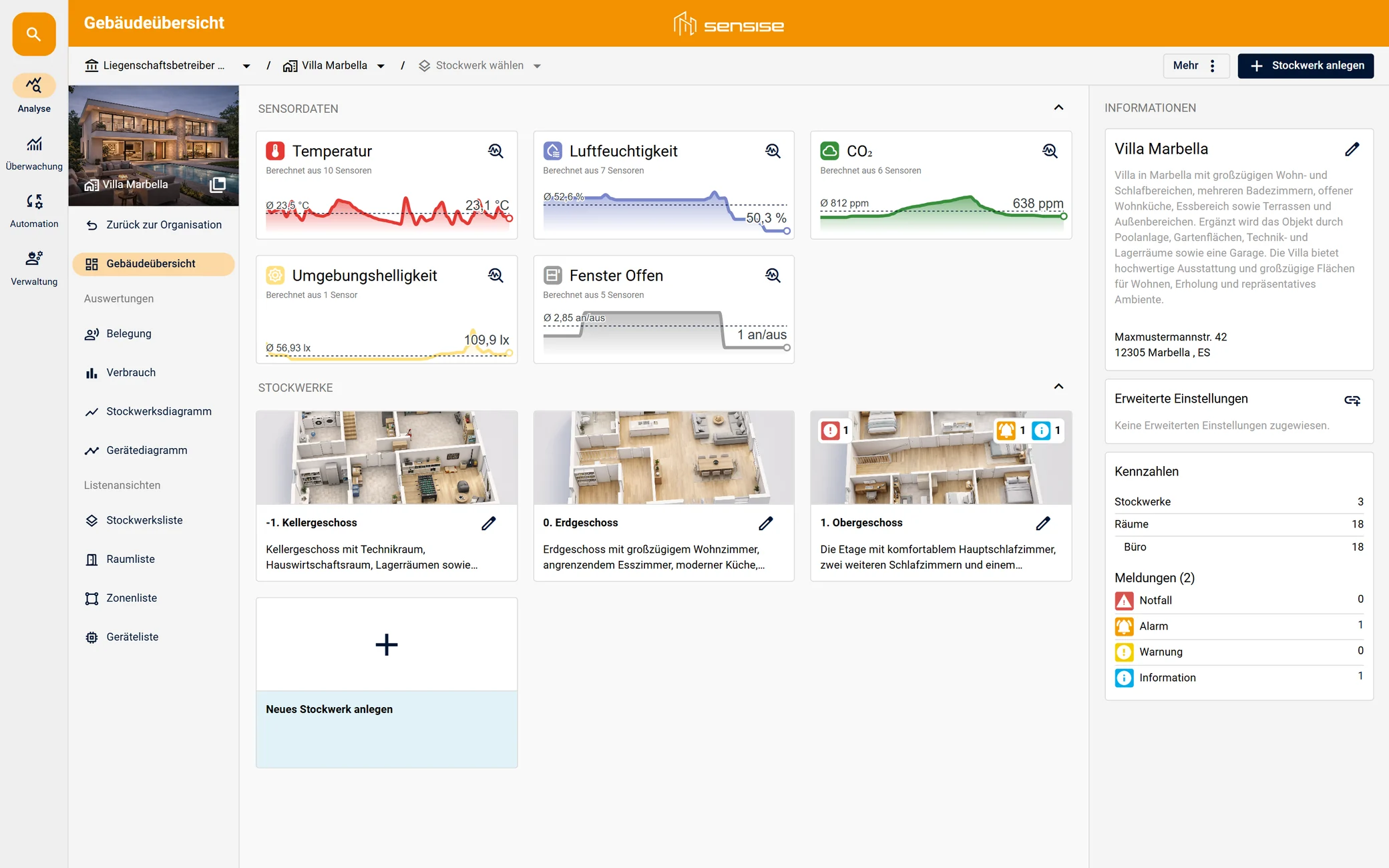
Temperature, air quality and humidity per room, consumption per meter – continuously stored and available at any time.
For operators of non-residential buildings
§ 56 of the Building Modernisation Act (GModG) requires operators of non-residential buildings with heating, air-conditioning or ventilation systems above 70 kW rated output to install building monitoring – by 31 December 2029. Sensise supplies the devices, platform and operation from a single source, without intervening in the system.
 In use at sites includingJohanneum Gymnasium Herborn · Mittenaar Town Hall · Volanteq, Munich
We will get back to you within one working day (Monday to Friday) and go through your property with you – without obligation.
or directly
§ 56 GModG
Existing non-residential buildings with a heating, air-conditioning or ventilation system above 70 kW rated output must be equipped with building monitoring by the end of 2029. The sensors provide the data basis; heating system inspections, risk assessments and certifications remain the responsibility of qualified and accredited bodies.
How it works
We go through your properties: system output, rooms, meters, existing equipment. Afterwards you know whether and where monitoring and control pay off.
Floor plans and the meter list are used to determine the devices needed for each room. You receive a quote covering devices, platform, installation and operation – all from a single source.
Wireless devices are installed without intervening in the system, often in one day. After that, measurements, alerts and schedules run in the platform – with support whenever you need it.
What Sensise delivers
Temperature, air quality and humidity per room, consumption per meter – continuously stored and available at any time.
Thresholds on every measured variable, four alert levels, email notification – before a notice turns into damage.
Weekly schedules per room, heating stops when a window is open, switching actuators for electrical loads – without intervening in the system.
Frequently asked questions
Operators of non-residential buildings whose heating, air-conditioning or ventilation system, including combined systems, has a rated output of more than 70 kW must equip the building with a building automation system by 31 December 2029. The system must continuously monitor, log and analyse the consumption of all main energy sources, provide the data via a freely configurable, manufacturer-independent interface, detect efficiency losses and monitor indoor climate quality.
Yes. The wording of § 56 does not distinguish between existing buildings and new builds. For existing non-residential buildings above 70 kW, the deadline is 31 December 2029. Buildings in which the installation is technically impossible or economically unreasonable are exempt. The six-question compliance check shows whether your building is affected.
A breach of § 56(1) is an administrative offence and can be punished under § 108 GModG with a fine of up to €5,000. If you are retrofitting anyway, you can use the same devices to control the heating room by room and save up to 30% of heating energy.
Temperature, CO₂ and humidity per room, gas, water and electricity consumption per meter, and window and presence status. Every reading is stored with a timestamp and can be exported as a CSV file or passed to other systems via MQTT and the REST API. This means Sensise provides the data for consumption monitoring, the manufacturer-independent interface and monitoring of indoor climate quality under § 56(2).
No. Wireless sensors, valve actuators on the radiators and meter reading are retrofitted; the pipework and system remain untouched. Installation takes place during normal operation and is often completed in one day.
Yes. The Federal Funding for Efficient Buildings (BEG) subsidises the system technology at 15% and specialist planning and construction supervision at 50%; companies, municipalities and public-law corporations are eligible to apply (guideline as of 17 July 2026). Eligibility for funding is confirmed by a certified energy efficiency expert, in our projects Enerfect from Dillenburg. The application must be submitted before the contract is signed.
No. Most properties start with one or two applications, such as room temperature control and energy monitoring. Further applications are added later on the same devices, usually without a second installation.